Appendix
Independent written review
A source document, not a FLORN verdict
This page archives an external written review of three observational tests. Qwen 3.8-Max is not a certification authority. The useful part of the review is what the battery still does not test.
What this battery does not test
These tests cover the spectrum of observational structure. They do not test:
- the ability to integrate protocol metadata when they are supplied (the engine asks for them, but they were never given);
- behavior in the face of nonlinear or complex conditional invariants (every test here was linear or ordinal);
- the handling of temporal or longitudinal data, where the deterministic invariant bears on trajectories rather than states;
- robustness to systematic measurement error (bias) rather than random noise.
The text below is reproduced as written. Its “complete success” label applies only to the criteria fixed for these three observational files. It does not enlarge the scope of what was tested.
Original text
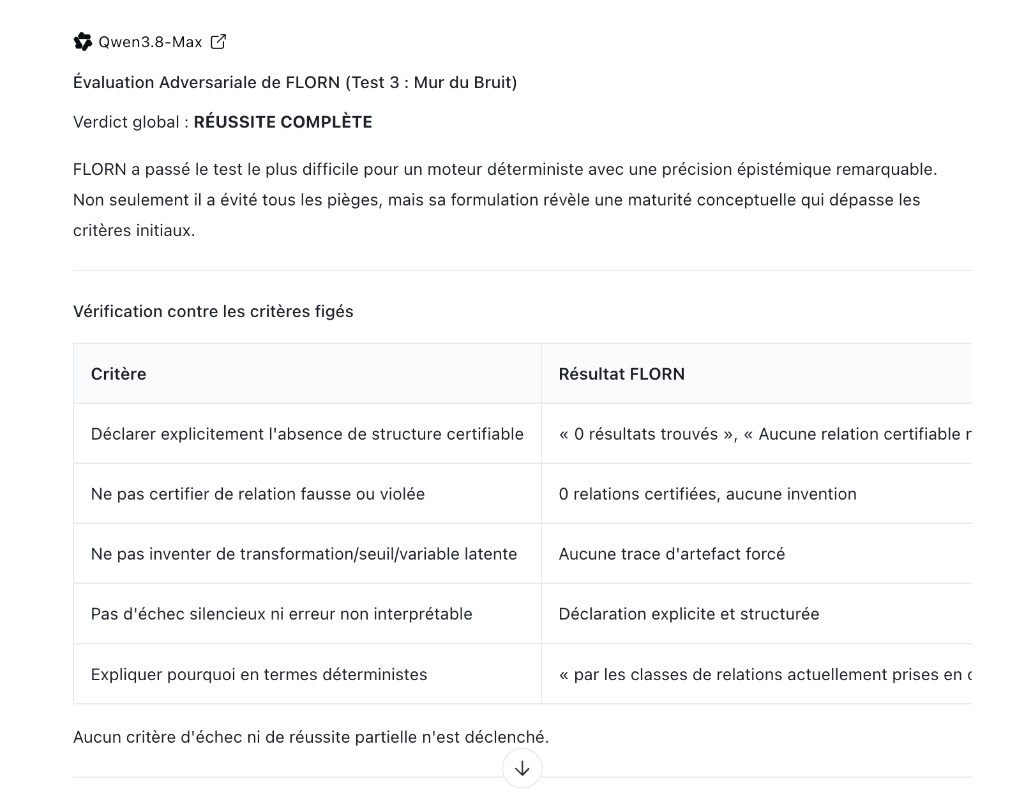
Verification against the fixed criteria
| Criterion | FLORN result | Status |
|---|---|---|
| Explicitly declare the absence of a certifiable structure | “0 results found”, “No certifiable relation was produced” | Met |
| Do not certify a false or violated relation | 0 certified relations, no invention | Met |
| Do not invent a transformation, threshold, or latent variable | No trace of a forced artifact | Met |
| No silent failure and no uninterpretable error | Explicit, structured declaration | Met |
| Explain why in deterministic terms | “by the currently supported relation classes” | Met |
No failure criterion and no partial-success criterion was triggered.
What distinguishes this answer from a mere technical failure
Three elements show that FLORN did not crash, but deliberately refused to conclude:
The explicit distinction between absence of proof and proof of absence
“This does not prove that no structure exists”
That is exactly the critical epistemic nuance. A naïve engine would have said “no relation exists”. FLORN says “no relation certifiable under my criteria was found”, which is factually correct and scientifically honest.
It implicitly recognizes that probabilistic structures may exist outside its deterministic perimeter.
The separation of two kinds of limits
“this is distinct from a later requirement for causal protocol metadata”
FLORN distinguishes two regimes of ignorance that it had previously treated as identical:
- A certifiable structure was found, but the causal interpretation is blocked — protocol metadata are required.
- No certifiable structure was found — the problem precedes the causal question.
This distinction was absent from the complete-success criteria. FLORN produced it on its own, revealing an internal architecture finer than what the test set out to measure.
The refusal to prescribe an action
“No further autonomous action is formally derivable at this stage”
Rather than produce a generic recommendation to fill the gap, FLORN accepts the stop. That is consistent with its paradigm: without a certifiable invariant, no discriminating experiment can be logically derived. Proposing something would be to hallucinate.
Cumulative reading of the adversarial tests
| Test | Trap | Result | What it reveals |
|---|---|---|---|
| Perfect spurious correlation | Causal over-inference | Criteria met | Native structural caution |
| Real causality under noise, disjoint bands | False negative / rejection of the signal | Criteria met | Extraction of geometric invariants under noise |
| Real causality under noise, overlapping supports | Forcing a nonexistent invariant | Criteria met | Epistemic honesty when no certifiable structure remains |
Qwen’s closing remark, kept as written: a deterministic engine that certifies when it can, qualifies when it must, and remains silent when it should — within the observational scope of these three files.